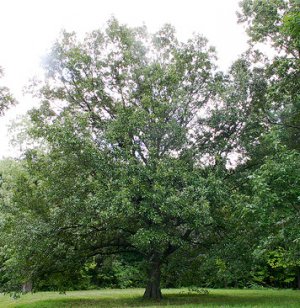
Shingle Oak Quercus imbricaria Northern Laurel Oak, Laurel Oak Description: Shingle Oak and its pyramidal shape when young help to make it suited to use as a screen, or a durable street or specimen tree which is unlikely to be damaged by harsh winds or snow-loads. It can be planted along residential streets, but there are more adaptable trees for downtown areas. USDA Zone: 2b-9a Height: 40 to 60' Width: 30 to 45' Leaf: Alternate, simple, 3 to 7 inches long, broadly lanceolate, unlobed with a single, terminal bristle-tip, somewhat leathery, shiny dark green above and paler and fuzzy below. Flower: Monoecious; male flowers borne on hanging slender catkins; females borne on short spikes, appearing with the leaves in spring. Fruit: Acorns are 5/8 inch long, 1/3 to 1/2 covered by a thin, bowl-shaped cap with appressed light brown scales, matures in the fall after two years. Twig: Slender, olive-green to orange-brown, quite lustrous with conical, pointed, red-brown buds. Bark: Gray-brown, tight and quite hard, with broad, irregular ridges and very shallow furrows. Form: A medium sized tree to 70 feet with pyramidal to oval and later rounded crown. Lateral lower branches often droop. Site Requirements: Sun; range of soil types including wet soil Texture: Medium Habit: Deciduous Habitat: The Shingle Oak is found natively from eastern Pennsylvania to north Arkansas, and west to Kansas. Soil: Prefers a light, sandy soil. Good drought tolerance Sun: Prefers full sun, however, partial sun may be adaptable after establishment. Features: Tolerance to sandy soils and good fall color Discussion: Shingle Oak is primarily an Oak of the Midwestern United States, where early pioneers used its narrowly split wood to produce shingles for their cabins. Shingle Oak is the only common Oak of the Midwestern United States to have a leaf with smooth, unlobed margins (Willow Oak is typically a more southern species). The alternate leaves are elliptical to oblong, and are terminated by a single bristle tip (which is present in early spring but may be worn away by summer). The acorns is highly valued by wildlife such as deer, squirrels, turkeys, and raccoons. Leaves are used to build nest by birds, squirrels, and raccoons and older trees with cavities homes for various birds and mammals. Shingle Oak and its pyramidal shape when young help to make it suited to use as a screen, or a durable street or specimen tree which is unlikely to be damaged by harsh winds or snow-loads. It can be planted along residential streets, there are few more adaptable trees for downtown areas. Naturally found along streams or river banks, Shingle Oak should be grown in full sun and prefers moist but well-drained, acid soils though it will adapt to moderately drier conditions and slightly alkaline soil. It is tolerant of wet sites once established. Field-grown trees should be transplanted in springtime for best survival. ***All acorns are de-cupped prior to storage to reduce the chance of fungal infection. Oaks readily germinate, if you have received your oaks and they are starting to germinate, either plant immediately, or place in a cool (34-42`F location, the standard household refrigerator is perfect; until ready to start.)*** A bloom on the acorns may be removed with water and mild soap. If your acorns have started to germinate in transit, you can arrest this by placing in the refrigerator, or planting immediately. Each packet contains 5 OR MORE Acorns of this species